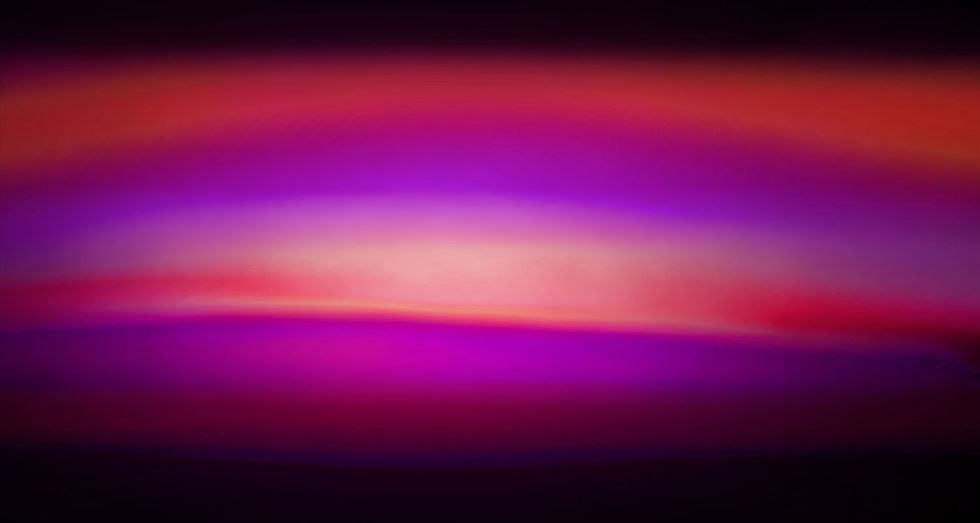
Skies Of Mars
Series
Fascinated by sunsets, I once read an article mentioning that sunsets on Mars are the polar opposite of our own. That detail immediately sparked my curiosity. According to various studies, the specific characteristics of the Martian atmosphere mean that days are perceived as reddish while sunsets appear bluish—exactly the reverse of what we observe daily on Earth.
On our planet, the sky appears blue due to the density of the atmosphere. Shorter wavelengths, which correspond to blue, scatter more easily, leading us to perceive the firmament in azure tones during the day; this phenomenon is known as Rayleigh scattering. As the Sun approaches the horizon, light must travel a greater distance through the atmosphere, causing the blue wavelengths to scatter away first and allowing the longer red wavelengths to finally reach our eyes, creating the sunsets we know.
On Mars, however, a different set of conditions completely alters this phenomenon. The gravity is lower, the atmosphere is thinner, and it is saturated with fine dust particles. These particles cause red wavelengths to scatter more uniformly. As a result, the sky is perceived as orange or reddish during the day, while bluish tones emerge near sunset.
Drawing from this scientific data, I began to imagine what those distant skies might look like. From that inquiry emerged a series of light-based pieces and photographs that attempt to portray an atmosphere so alien, yet so deeply embedded in the science-fiction imagination. These works function as a form of visual speculation on other possible landscapes. While various scientific circles project the possibility of inhabiting other planets, through art, we can also ask ourselves what those horizons would look like and what kind of experience it would be to contemplate a sky unlike any we have ever known.